
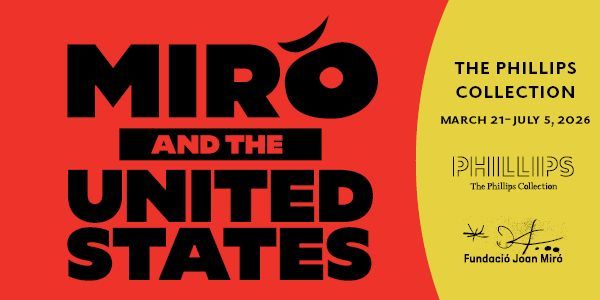
Following its presentation in Barcelona, 'Miró and the United States' is now on view in Washington, DC, at The Phillips Collection, with the support of Puig. The exhibition continues to explore the vibrant and reciprocal exchanges between Joan Miró and the American art scene, shedding new light on a defining chapter of 20th-century creativity.
Originally conceived by the Fundació Joan Miró, the exhibition traces a lesser-known yet pivotal moment in Miró’s career, when his encounters with the United States opened new artistic horizons and contributed to shaping post-war art on both sides of the Atlantic.
For Miró, the United States represented more than a destination, it embodied a space of creative freedom, experimentation, and possibility. Between 1947 and 1968, seven journeys to the country allowed him to build lasting relationships with artists, architects, gallerists, and institutions, enriching his practice and expanding his international presence.
Bringing together around 75 works, including paintings, sculptures, works on paper, and archival materials, the exhibition creates a dynamic dialogue between Miró and a generation of American artists. Figures such as Alexander Calder, Louise Bourgeois, Jackson Pollock, Mark Rothko, and Helen Frankenthaler reflect the depth and diversity of these exchanges, highlighting how artistic experimentation transcended borders and disciplines.
Through these encounters, Miró’s work evolved in both scale and expression. His dialogue with Calder and Bourgeois informed new sculptural explorations, while his engagement with Abstract Expressionism—through artists like Pollock—introduced a more gestural and energetic approach to painting. Collaborations with architect Josep Lluís Sert further expanded his vision into the realm of public art and monumentality.
The exhibition also revisits key milestones that anchored Miró’s presence in the United States, including his long-standing relationship with dealer Pierre Matisse and his retrospectives at the Museum of Modern Art in 1941 and 1959. Coming from a Spain marked by the Franco dictatorship, Miró found in America not only a creative frontier, but a landscape of openness, innovation, and hope.At a time when cultural exchange continues to shape global perspectives, the exhibition resonates with renewed relevance. As noted by Jonathan P. Binstock, presenting Miró and the United States in Washington underscores the role of art in fostering dialogue across geographies and generations, inviting audiences to reflect on the enduring power of creativity as both a personal and collective force.
By tracing these transatlantic connections, 'Miró and the United States' deepens the understanding of Miró’s legacy—revealing how artistic encounters can spark new forms of expression and contribute to a shared cultural language that continues to evolve.
Puig’s support of the exhibition reflects its enduring commitment to fostering creativity through cultural dialogue. As part of its “Home of Creativity” positioning, Puig champions initiatives that celebrate its heritage while looking toward the future, where legacy and innovation come together to shape an environment in which creativity can thrive.
The exhibition is on view at The Phillips Collection through July 5, 2026.
Image credit, courtesy of Fundació Joan Miró:
- © Joan Miró, Ciphers and Constellations in Love with a Woman from the Constellations Series, 1959, Fundació Joan Miró, Barcelona
- © Joan Miró, The Red Sun, 1948, The Phillips Collection
- © Joan Miró, Woman and Birds at Sunrise, 1946, Fundació Joan Miró, Barcelona